
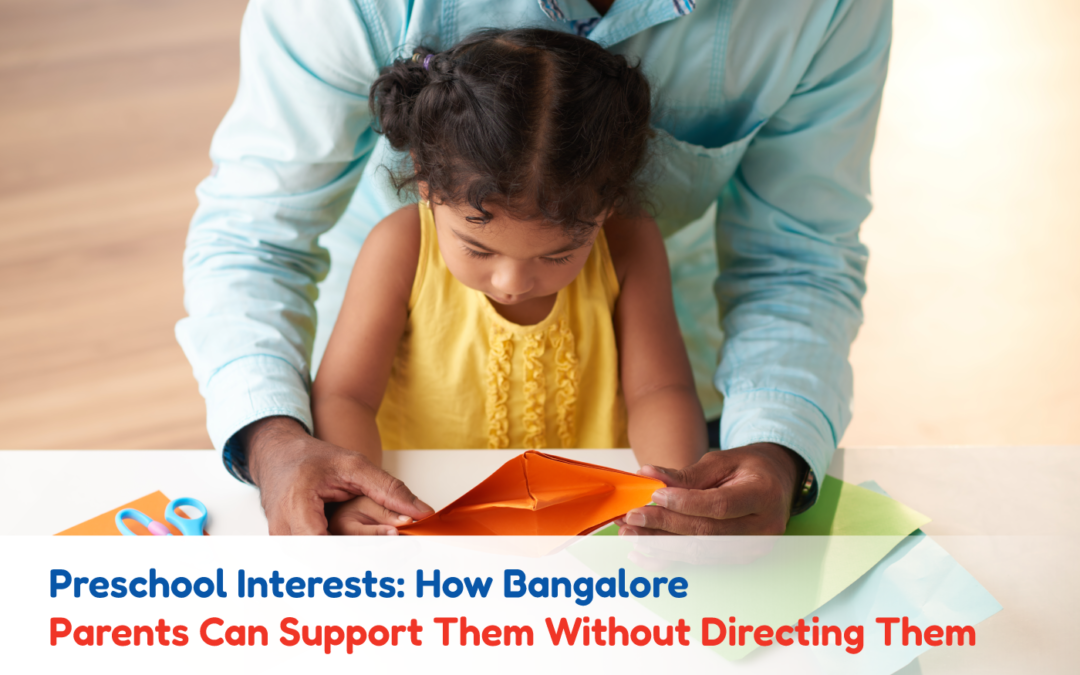
Preschool Interests Develop Naturally in Early Childhood
Preschool interests begin forming much earlier than most parents realise. They emerge quietly through repetition, comfort, and familiarity, not through instruction or structured learning. In the preschool years, children are drawn to activities that feel safe and meaningful to them, even if those choices appear simple or repetitive to adults.
For parents in Bangalore and across India, where early academics and extracurricular exposure are often prioritised, it is easy to step in too soon. However, preschool interests grow best when children are allowed to explore freely, without pressure to perform or progress.
What Are Preschool Interests and How Can Parents Identify Them?
Preschool interests are the activities, materials, or experiences that a child chooses repeatedly during free play. At this age, children do not explain their interests verbally. They communicate through behaviour.
Parents may notice preschool interests when a child returns to the same toy or activity over several days, spends extended time with certain materials, shows strong reactions to specific stories or sounds, or prefers observing other children before joining play.
These interests are not fixed. They shift with mood, environment, and emotional comfort. Supporting preschool interests does not mean turning them into skills or outcomes. It means noticing patterns without attaching expectations.
Why Observation Is Key to Supporting Preschool Interests
Preschool interests become clearer when parents observe rather than direct. Observation involves noticing what children choose during unstructured time, how often they repeat activities, and whether they make small variations over time.
Some children repeat actions exactly, while others explore gradually. Both are signs of engagement. Frequent adult instructions, suggestions, or corrections can interfere with this process, making it harder for preschoolers’ interests to develop naturally.
In Indian households, where adults are often closely involved in children’s play, stepping back can feel uncomfortable. Yet this pause is essential for genuine interest to emerge.
How Parental Expectations Can Influence Preschool Interests
Parental expectations can quietly shape preschool interests. Extra praise, encouragement, or attention around certain activities may lead children to repeat those actions to gain approval rather than from genuine interest.
Over time, this can turn exploration into performance. Children may continue activities they believe adults value, especially in environments where comparison with peers is common. Neutral, consistent responses help ensure that preschool interests remain child-led.
Research on how educators interpret and respond to children’s interests in early years classrooms by ScienceDirect.com shows that adult expectations can influence how children’s interests are recognised, extended, or unintentionally redirected.
When Preschool Interests Are Mistaken for Behavioural Issues
Many behaviours often labelled as concerns are actually expressions of preschool interests. Repetition may be seen as stubbornness, quiet focus as disengagement, switching activities as lack of attention, or watching peers as social hesitation.
Misreading preschool interests as behavioural problems can lead to unnecessary correction and interruption of engagement. Understanding this distinction helps parents respond with patience rather than redirect.
Why Preschool Interests Need Time, Pauses, and Patience
Preschool interests are not continuous. Children may move away from an activity for days or weeks and return later. A pause does not mean loss of interest or boredom.
In fast-paced urban settings like Bangalore, parents may feel pressure to replace pauses with new classes or activities. However, allowing space supports deeper and more meaningful re-engagement.
Preschool Interests Grow Best in Emotionally Safe Environments
Preschool interests thrive when children feel emotionally secure. Calm routines, unhurried time, and acceptance allow children to explore freely. Interests develop through play, curiosity, and social interaction, not through early instruction.
Parents do not need to create or direct interests. By observing, waiting, and trusting the process, they support confidence, autonomy, and long-term engagement.
At Kids Castle Preschool, this approach is reflected in play-based learning environments that respect each child’s pace, allowing preschool interests to develop naturally and meaningfully.
FAQs
1.What are Preschool Interests in early childhood?
Preschool interests are the activities, toys, stories, or experiences that a young child chooses repeatedly during free play. In the preschool years, interests develop through curiosity and comfort, not through instruction. Children may not talk about their interests, but they show them through repetition, focus, and preference.
2. How can parents in Bangalore identify Preschool Interests at home?
Parents can notice preschool interests by observing what their child chooses during unstructured time, especially at home. Repeated play with the same toys, long periods of quiet focus, strong reactions to certain stories or music, or watching other children before joining are common signs. These patterns matter more than how “educational” an activity appears to be.
3. Should Preschool Interests be encouraged with classes or structured activities?
Not always. While classes can be beneficial later, preschool interests develop best when they are not rushed into structured learning. In cities like Bangalore, where activity overload is common, too many classes can reduce a child’s natural curiosity. Free play and unstructured time are essential for genuine interest to grow.
4. Is it normal for Preschool Interests to change frequently?
Yes. Preschool interests are naturally fluid. A child may show deep interest in one week and move away the next. This does not indicate poor attention or boredom. It reflects normal emotional and developmental changes. Allowing these shifts without pressure helps interests re-emerge naturally.
5. Are Preschool Interests linked to future skills or talents?
Preschool interests lay the foundation for future learning, but they do not predict specific skills or careers. For example, interest in building, stories, or movement supports attention, problem-solving, and confidence. Parents should avoid turning interests into expectations, as this can limit exploration.
6. Why do some Preschool Interests look like behaviour issues?
Many behaviours misunderstood as concerns are actually expressions of interest. Repetition may be seen as stubbornness, quiet play as disengagement, or watching others as hesitation. When parents recognise these as preschool interests, they can respond with patience instead of correction.
7. How can Indian parents support Preschool Interests without pressure?
Parents can support preschoolers’ interests by observing without interrupting, responding neutrally rather than praising selectively, allowing pauses without immediately replacing activities, and avoiding comparisons with other children. Emotional safety and time are more important than outcomes.
8. How does a play-based preschool support Preschool Interests?
A play-based preschool provides space, materials, and time for children to explore at their own pace. Teachers observe rather than direct, allowing preschool interests to develop naturally. At Kids Castle Preschool, this approach helps children build confidence, independence, and a genuine love for learning.
9. Are Preschool Interests important for school readiness in India?
Yes. Preschool interests support attention, emotional regulation, communication, and problem-solving. These skills are essential for school readiness and long-term learning, especially in structured academic environments common in Indian schools.