
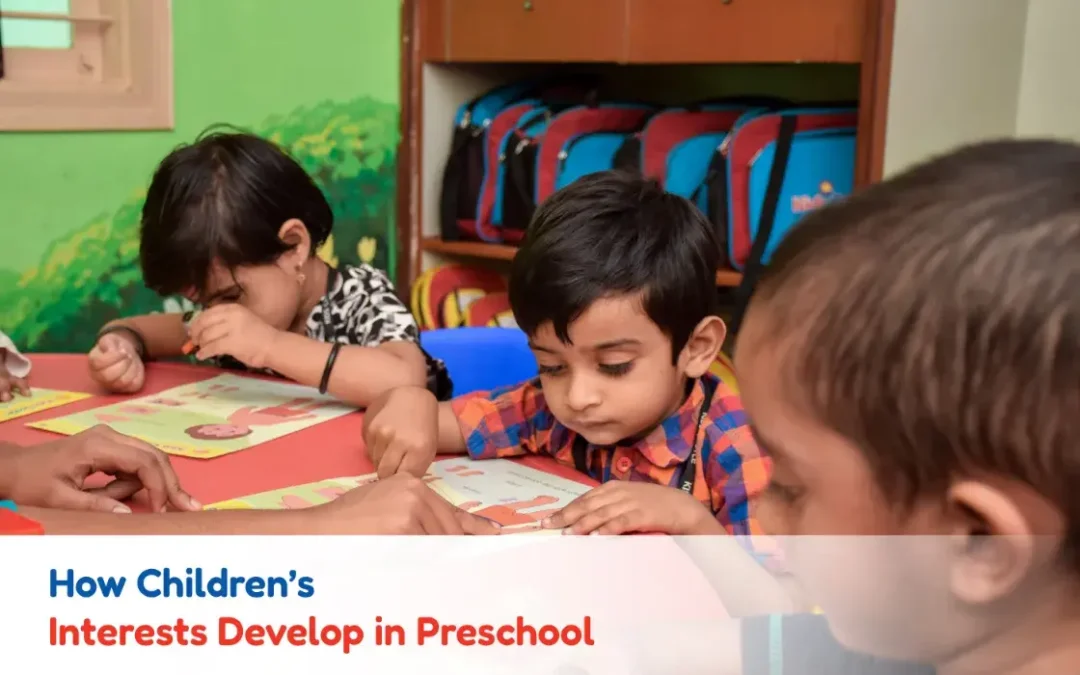
Children’s interests develop naturally in preschool through everyday exposure, exploration, play, and social interaction. When children feel safe, supported, and unpressured, they begin to gravitate toward activities that genuinely capture their attention. Preschool environments play an important role in nurturing this process by allowing curiosity to grow at an individual pace.
Children’s interests are shaped through:
- Repeated exposure to sounds, objects, and experiences
- Open-ended exploration without rigid direction
- Social interaction and observation of peers
- Play that allows repetition and deeper engagement
- A safe, inviting environment that encourages choice
Understanding how children’s interests develop helps parents and educators support learning in a way that feels natural rather than forced.
The Natural Development of Children’s Interests in Preschool Years
Every child enters preschool with curiosity. Some children observe quietly, others explore actively, and some alternate between the two depending on mood and energy levels. These small, everyday actions gradually lead to the development of preferences and interests.
Preschool provides a setting where children feel relaxed enough to explore without expectation. Through free movement, play, and interaction, children begin to discover what fascinates them. This process is rarely planned and does not follow a fixed timeline, which is why preschool years are especially important for interest development.
How Do Children’s Interests Begin to Form in Preschool?
Children’s interests often begin with simple exposure. A sound, an object, a movement, or a material may catch a child’s attention. With repeated exposure, familiarity grows, and curiosity deepens into interest.
Preschools offer a wide range of sensory and experiential opportunities that support this discovery. According to the National Association for the Education of Young Children (NAEYC), play-based learning environments encourage exploration, engagement, and the natural development of interests in early childhood.
A calm and welcoming environment is essential. When children feel emotionally safe, they are more likely to explore freely, revisit activities, and follow their curiosity without hesitation.
According to UNICEF India, early childhood education forms the foundation for children’s cognitive, social, and emotional development.
How Children’s Interests Grow Through Everyday Exploration
Everyday exploration plays a significant role in shaping children’s interests. Activities such as watching peers, interacting with materials, or moving through different learning spaces help children discover what holds their attention.
Preschool environments support this by offering variety without pressure. Children are not required to explore with a specific outcome in mind. Over time, repeated moments of curiosity gradually become sustained interests.
This freedom to explore also builds confidence. When children make choices independently, they begin to trust their instincts and preferences.
How Social Interaction Shapes Children’s Interests
Social interaction strongly influences the development of children’s interests. Many children become curious about activities simply by observing others.
Preschool settings function as small communities where children learn naturally through shared experiences. Seeing peers enjoy an activity often encourages children to try it themselves. This type of learning happens without instruction or pressure, making it both effective and enjoyable.
Observation, imitation, and shared discovery help children expand their interests in a gentle and organic way.
How the Preschool Environment Supports Children’s Interests
An effective preschool environment is designed to encourage exploration. Open spaces, accessible materials, and inviting activity areas allow children to move freely and choose where to engage.
When children feel comfortable, they are more likely to revisit activities, explore deeply, and experiment with new ideas. A thoughtfully planned environment gives children confidence in their choices, which strengthens curiosity and fosters a positive relationship with learning.
How Children’s Interests Develop Through Play
Play is one of the most powerful ways children explore their interests. Through play, children test ideas, observe outcomes, and repeat activities that bring enjoyment.
Repetition reinforces familiarity and satisfaction. When children return to an activity repeatedly, interest deepens naturally over time. Play also supports focus and sustained engagement, allowing children to spend more time on activities that genuinely matter to them.
How Adults Can Support Children’s Interests Without Directing Them
Adults play an important role by observing rather than directing. By noticing what interests a child and providing gentle support, adults help curiosity flourish without imposing expectations.
Simple actions such as offering materials, allowing uninterrupted time, and acknowledging curiosity can make a meaningful difference. When support feels natural and responsive, children feel encouraged rather than guided, which strengthens confidence and interest.
How Children’s Interests Appear in Daily Preschool Life
Children’s interests often appear in small, everyday moments. These signals may include:
- Repeatedly choosing the same activity
- Spending increasing amounts of time on specific tasks
- Showing enthusiasm in certain group settings
- Focusing closely on particular books, toys, or spaces
Research from Harvard’s early childhood studies shows that children’s interests grow most naturally in environments that allow free exploration and child-led choices, making preschool settings especially supportive of this process.
How Children’s Interests Influence Confidence and Growth
When children engage in activities they enjoy, confidence grows. Familiar experiences help children feel secure, while exploration encourages curiosity. Over time, children learn to trust their own decision-making.
This process supports:
- Comfort with familiar activities
- Openness to new experiences
- Confidence in personal choices
- Positive engagement with learning
Children’s interests lay the foundation for lifelong curiosity and self-directed growth.
How Parents Can Support Children’s Interests at Home
Parents can support children’s interests by observing what captures their attention and allowing exploration without pressure. Everyday experiences such as playtime, shared activities, and unstructured moments provide valuable learning opportunities.
Support may include:
- Noticing activities children return to often
- Providing time for uninterrupted play
- Encouraging exploration rather than outcomes
- Participating in shared activities that spark interest
When parents follow a child’s lead, learning becomes a joyful and meaningful experience.
Why Children’s Interests Matter in the Early Years
Early interests shape how children engage with the world. When children feel supported in exploring their interests, they develop a positive relationship with learning.
Children’s interests matter because they:
- Encourage natural engagement
- Build confidence through familiarity
- Cultivate curiosity over time
- Promote a positive attitude toward learning
Conclusion
Children’s interests develop through daily experiences, gentle exploration, and supportive environments. Preschool plays a vital role by providing space, freedom, and emotional safety for children to discover what fascinates them. When children feel relaxed and encouraged, curiosity grows naturally, laying a strong foundation for lifelong learning. At Kids Castle Preschool, thoughtfully designed spaces and child-led activities create opportunities for children to explore interests at their own pace, helping curiosity turn into confidence. Learn more about Kids Castle Preschool.